Most map tasks show the same place at two points in time, for example a village in 1990 and in 2020, or a town centre today and a plan for its future. Some show a floor plan or three maps. Unlike a line graph, a map is mostly about features and their positions, not numerical trends; if it labels a number that matters, such as the number of floors, include it. As with every Academic Task 1, spend about 20 minutes and write at least 150 words: Task 2 counts twice as much.
Before writing, compare the maps feature by feature: is each one new, gone, changed or still there? Then choose what goes into the report, and group small details by area instead of listing every symbol.
Don't skip maps in practice. In 2026 exam reports on Reddit's r/IELTS, maps were the Task 1 type test-takers mentioned most often (20 of 70 reports that named an Academic Task 1 type), usually as a surprise. These are self-reported memories, so they show what people noticed, not how often maps appear.
Map answers start relatively strong. On GoPrep, the average first map answer scored 6.0, and fewer than 1 in 5 was under 150 words, the lowest share of any Task 1 type:
| Task 1 type (students) | Under 150 words | No summary words | Average first band |
|---|---|---|---|
| Pie chart (1,186) | 37% | 26% | 5.5 |
| Line graph (1,453) | 35% | 20% | 5.5 |
| Process (537) | 32% | 19% | 6.0 |
| Table (239) | 26% | 8% | 6.0 |
| Bar chart (417) | 24% | 11% | 6.0 |
| Mixed charts (566) | 23% | 16% | 6.0 |
| Map (371) | 18% | 11% | 6.0 |
In GoPrep AI examiner feedback (28 July to 26 September 2026), fixes to describing figures appeared in 22% to 25% of bar chart, pie chart and table answers, and fixes to comparisons in 21% to 28% (867, 2,148 and 444 answers). On maps those shares were 4% and 6% of 759 answers. The most common map fixes concern prepositions, subject-verb agreement and articles.
What the examiner checks
Your answer gets four scores of equal weight, and the Task 1 band is their average. On a map, each one looks like this:
- Task Achievement: the main changes, an overview, accurate details.
- Coherence and Cohesion: one clear order through the map.
- Lexical Resource: precise change verbs and location words.
- Grammatical Range and Accuracy: passives, tenses, articles and prepositions.
The official band descriptors ask for "a clear overview" with main trends or differences identified at band 7. At band 6, "a relevant overview is attempted". That is one requirement among several, not a guarantee of the band.
The 4-paragraph structure
- Introduction. One sentence that paraphrases the task: which place and which years.
- Overview. One or two sentences on the main changes, plus what stayed the same.
- Body paragraph 1. The biggest changes, grouped by area.
- Body paragraph 2. The remaining changes and the features that didn't change.
Pick one order and keep it. Going area by area works for two maps. For three maps from different years, going period by period is usually clearer.
How to choose what to include
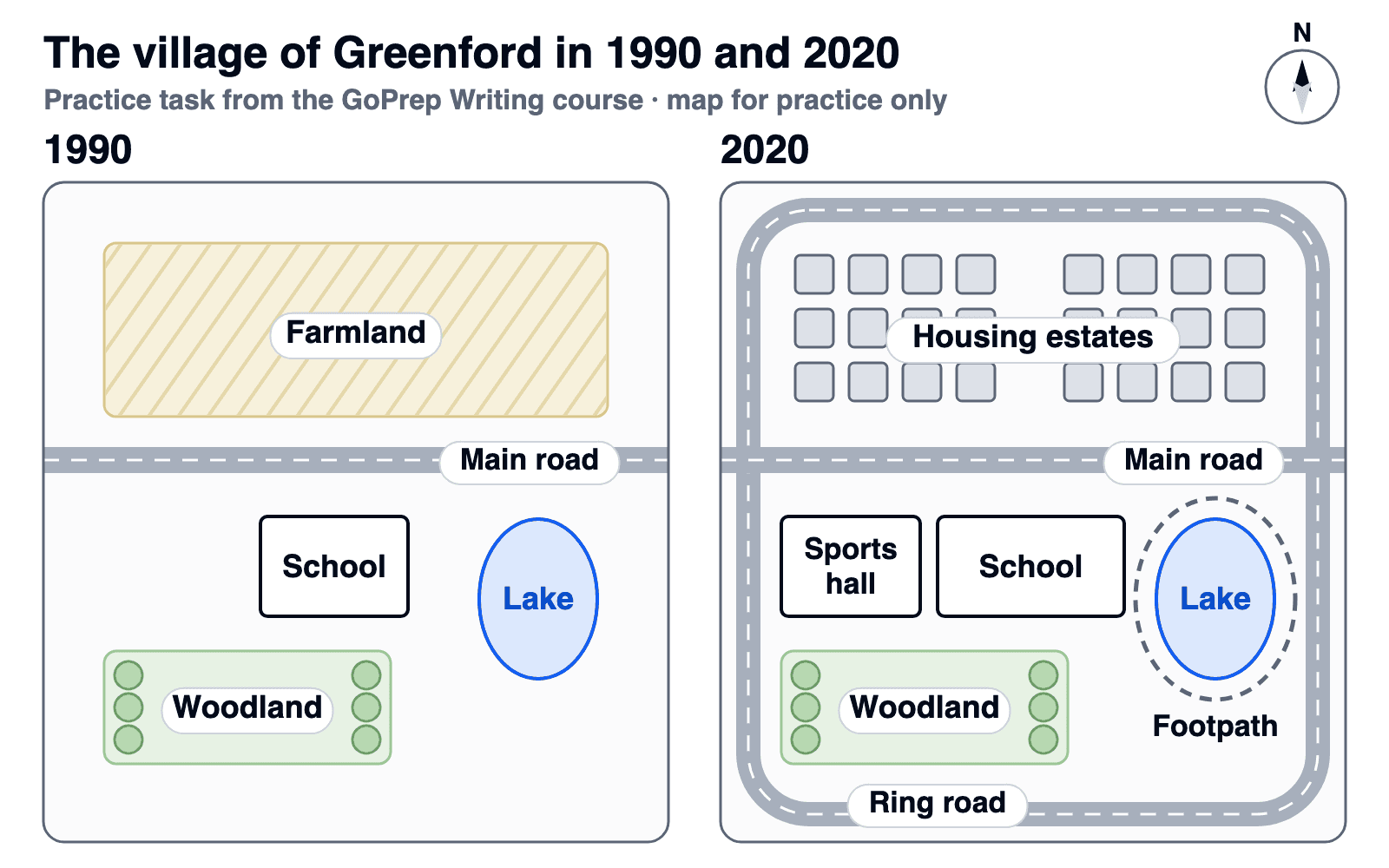
Greenford, the practice map used throughout this guide, has about ten labelled features. Not every one earns its own sentence: write one sentence per area, not one per symbol.
| Feature on the map | In the report? | Why |
|---|---|---|
| Farmland in the north, housing estates in 2020 | Yes: overview and body | The biggest change: a whole area got a new use |
| Single houses in the estates | No | Describe the estates as one area |
| School extended, sports hall beside it | Yes: one sentence | Two changes in the same area |
| Main road kept, ring road added | Yes: one sentence | Road changes matter; group both roads |
| Woodland and lake | Yes: overview and last paragraph | What stayed is part of the comparison |
| Footpath around the lake | Yes: one clause | The only change in the east |
How to write the overview for a map
Start with Overall, and answer one question: how did the character of the place change? Did it become more built-up or more residential? Were new roads or paths added? Then add what survived. Keep single buildings and exact positions for the body. For overviews of every chart type, see how to write a Task 1 overview.
Details without an overview
In 1990 there was farmland in the north, but in 2020 there were houses. A sports hall was built next to the school.
Both sentences are accurate, but the reader still doesn't know what happened to the village as a whole.
A clear overview
Overall, Greenford became much more built-up between 1990 and 2020, while its woodland and lake were left in place.
It names the main change and what stayed, which proves you saw the village as a whole, not a list of new buildings. More residential would work too: it names the kind of place the village became.
Language for maps: change verbs and location
A useful map sentence has two parts: a change verb plus a location. A sports hall was built is complete, but it doesn't say where. A sports hall was built next to the school does.
Most change verbs are passive: the place matters, the builder doesn't.
| What happened | Verbs | Example |
|---|---|---|
| Something new | was built, was constructed, was added, was laid out | A sports hall was built next to the school. |
| Something removed | was demolished, was knocked down, was cleared | The farmland was cleared. |
| One thing became another | was replaced by, was converted into, was turned into | The farmland was replaced by housing estates. |
| Something grew | was extended, was enlarged, was widened | The school was extended to the east. |
| No change | remained, was kept, was left unchanged | The woodland was left unchanged. |
Was replaced by means the old thing went and something new took its place. Was converted into means the same building got a new use: the warehouse was converted into flats. Now the location:
| Position | Phrases | Example |
|---|---|---|
| A part of the place | in the north, in the south-west, in the centre | Housing estates were built in the north. |
| Outside something, in one direction | to the north of, to the east of | The lake lies to the east of the school. |
| Beside | next to, beside, adjacent to | The sports hall stands next to the school. |
| Facing | opposite, across the road from | The housing is opposite the school, across the main road. |
| Lines and routes | along, around, through, from east to west | A footpath was laid out around the lake. |
The same position language carries the answers in IELTS Listening map labelling.
Five grammar checks for map answers, based on GoPrep feedback
In its feedback on Writing answers, GoPrep's AI examiner lists the few fixes that matter most for the next band. The percentages show the share of answers with at least one suggestion of that type. One answer can fall into several categories, and this is not a full count of errors.
| Fix | Map answers | Typical slip and fix | Check before you submit |
|---|---|---|---|
| Prepositions | 39% | on the north of the village → in the north of | In the north inside the place, to the north of outside it |
| Subject-verb agreement | 38% | Two estates was built → were built | Was or were agrees with the subject |
| Articles | 33% | in north → in the north | The before north, south, centre |
| Passive | 29% | A hall built → A hall was built | In passive clauses, check the form of be and the past participle: was built, were removed, will be converted |
| Tense | 11% | was built for a 2030 plan → will be built | Each verb matches its map's date |
The passive also does most of the work in a process diagram, so practising it here pays off twice.
Choose the tense for each map:
- Two past dates (1990 and 2020): past passive, was built, was replaced by.
- A past date and today: past passive for what changed (was extended), or present perfect passive to stress the result now (has been extended); present simple for how it looks now, the school currently stands beside the road.
- Today and a plan: present simple for today, future passive for the plan, will be converted into.
- One map with no dates: present simple, the school is located next to the lake.
Don't switch tense at random: each verb should match the date of the map it describes.
A floor plan with no compass
Some tasks show the inside of a building, often now and after planned changes. There is usually no compass, so give positions from the entrance: straight ahead of the entrance, on the left as you enter, at the back on the right. Try this short task before reading the answer.
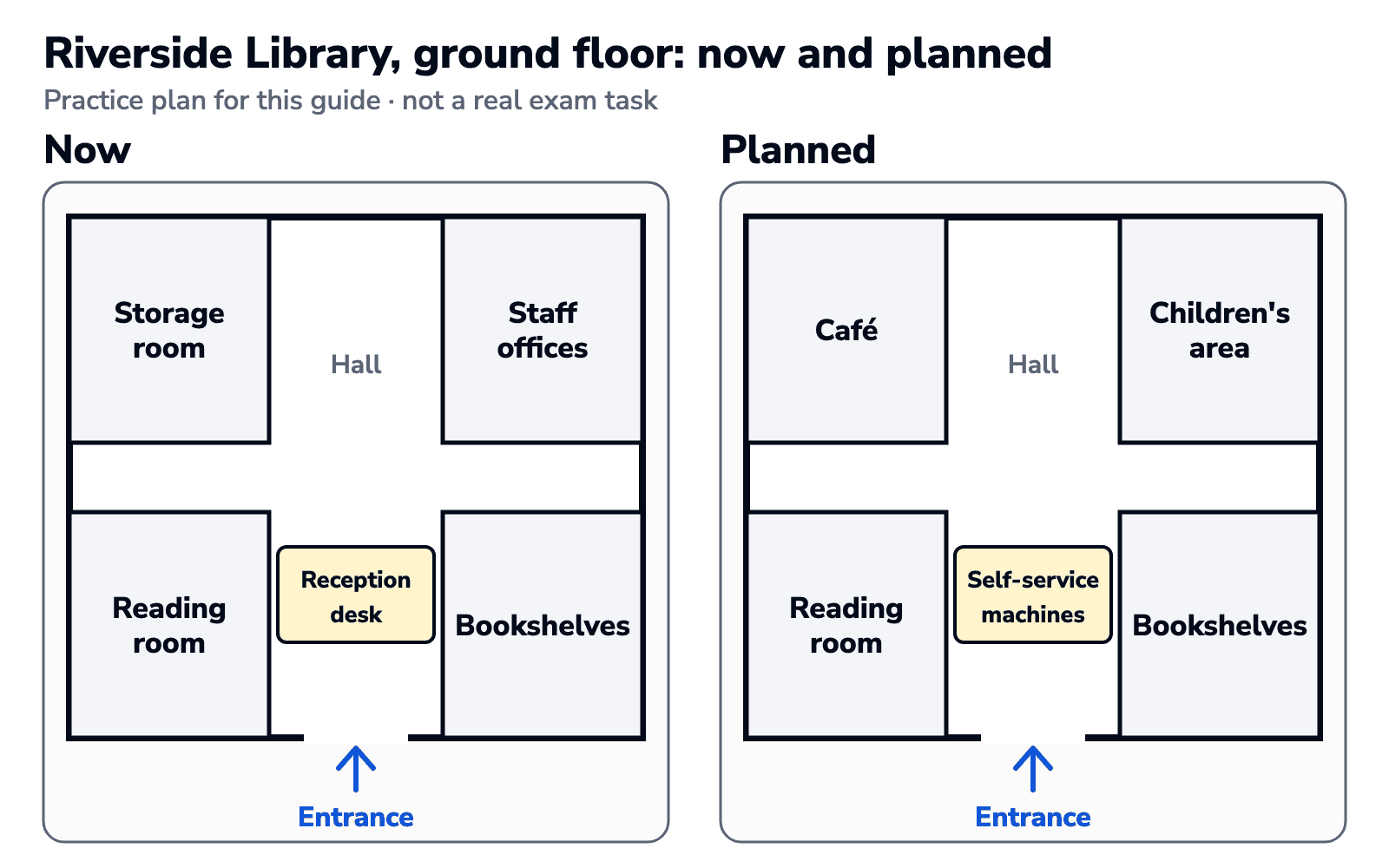
The plans show the ground floor of Riverside Library now and after planned changes. Summarise the information by selecting and reporting the main features, and make comparisons where relevant.
| Position from the entrance | Now | Planned |
|---|---|---|
| Straight ahead | Reception desk | Self-service machines |
| Front left | Reading room | Reading room (unchanged) |
| Front right | Bookshelves | Bookshelves (unchanged) |
| Back left | Storage room | Café |
| Back right | Staff offices | Children's area |
Two ways to group it: walk from the entrance to the back, or group by change: the three changes, then the two rooms that stay the same. This short answer describes the three changes first, then names the two unchanged rooms in the same paragraph; in a full answer you can split these groups into two paragraphs.
The plans show the ground floor of Riverside Library at present and after some planned changes.
Overall, both rooms at the back will be given new uses and the reception desk will be replaced, while the reading room and the bookshelves will stay as they are.
Straight ahead of the entrance, the reception desk will be replaced by self-service machines. At the back, the storage room on the left will be converted into a café, and the staff offices on the right will be turned into a children's area. The reading room on the left of the entrance and the bookshelves opposite it will remain unchanged.
Locations are described from the entrance, and every planned change uses the future passive.
Practice: a full map task with a model answer
This task is from the GoPrep Writing course.
The maps above show the village of Greenford in 1990 and in 2020. Summarise the information by selecting and reporting the main features, and make comparisons where relevant.
| Area | 1990 | 2020 |
|---|---|---|
| North | Farmland | Two housing estates |
| Centre | School | School extended to the east; sports hall built immediately west of it |
| Roads | Main road from east to west | Main road kept, ring road added around the village |
| South-west | Woodland | Woodland (unchanged) |
| East | Lake | Lake kept, footpath added around it |
Check a weak draft first
This body paragraph has slips that are common in map answers. Find them before reading the table.
In 2020 farmland was replaced by houses. School became bigger and sports hall built. A huge ring road was added, so it is easier to get to the school now. The woodland in the south-east did not change, and the lake was also the same.
| Weak draft | What the map shows | Fixed |
|---|---|---|
| farmland was replaced by houses | Farmland in the north became two housing estates | In the north, the farmland was replaced by two housing estates. |
| School became bigger and sports hall built | The school grew east; the hall is west of it | The school was extended to the east, and a sports hall was built on its western side. |
| A huge ring road... so it is easier to get to the school | A ring road; no reason or effect is shown | A ring road was added around the edge of the village. |
| The woodland in the south-east | The woodland is in the south-west | The woodland in the south-west was left unchanged. |
| the lake was also the same | A footpath now goes around the lake | The lake remained, although a footpath was laid out around it. |
Every fix adds a location, puts back a missing word or removes something the map doesn't show. None needs harder vocabulary.
Model answer (157 words)
The maps compare the village of Greenford in 1990 and 2020, showing how its layout changed over this thirty-year period.
Overall, Greenford became much more built-up, as housing replaced the farmland and new facilities and roads were added. Its natural features, the woodland and the lake, were kept.
The most dramatic change took place in the north of the village, where the farmland was cleared and replaced by two housing estates. In the centre, just south of the main road, the school was extended to the east, and a new sports hall was built next to it on its western side. The road network also grew: the main road running from east to west was retained, while a ring road was added around the edge of the village.
By contrast, the woodland in the south-west occupied the same area on both maps. The lake in the east also remained, although a footpath was laid out around it.
Why it works: the overview has no single buildings, the body goes area by area, and every change has a verb and a place, in the past because both dates are past.
FAQ
How do I describe a map in IELTS Writing Task 1?
Compare the maps feature by feature: new, gone, changed or still there. Then write an introduction, an overview of the overall change and two body paragraphs organised by area. Make the location of every change clear.
Which tense should I use for an IELTS map?
Match the tense to each map. Past changes take the past simple, often passive (was built). A map of today takes the present simple. A future plan takes the future passive (will be built).
Do I need a conclusion in a map task?
No separate conclusion is needed. Task 1 rewards a clear overview of the main changes: put it after the introduction or at the end, but write it only once.
How do I describe three maps?
Go through time, period by period: what the first map shows, what changed by the second, what changed by the third. In the overview, describe the direction of change across all three maps.
What if the map has no compass?
Describe positions relative to other features: next to the school, opposite the station, along the river. These phrases work on any map.
How many words should a map answer have?
At least 150. As a practical guide, 160 to 190 words is usually enough to cover the main changes area by area and what stayed the same. Going much longer takes time away from Task 2.
Do maps appear in IELTS General Training?
No. In General Training, Writing Task 1 is a letter. Visual tasks, maps included, belong to Academic Writing Task 1.
Where to practise next
Rereading your report shows whether every change has a verb and a place. The next step is a plan: tell the quiz your target score, your exam date and the part of IELTS you want to improve, and GoPrep will build a personal study plan around your answers.
For more Task 1 practice, read the line graph guide or the Task 1 vocabulary guide.

GoPrep Team
GoPrep guide authors
We write about IELTS preparation using platform data and official exam materials.
All articles by GoPrep Team