A process diagram, sometimes called a process chart, shows how something is made or how something happens in nature: labelled stages joined by arrows. In Academic Writing Task 1 you describe those stages in order, in at least 150 words and about 20 minutes. The official format page lists "describe stages of a process or procedure" among the skills this task tests.
The main focus is the sequence of stages. Your overview names the main stages and where the process starts and ends; the body walks through them in order. If the diagram shows quantities, temperatures or durations, include them.
In GoPrep data, 32% of first process diagram answers were under 150 words, and 19% had none of the usual summary words such as overall or in general (537 students, 28 July to 26 September 2026). When students tried again, 54 of the 75 who had fallen short reached 150 words, and 18 of 29 added summary words.
Answers under 150 words showed up in all seven Task 1 types, not only in process:
| Task 1 type (students) | Under 150 words | No summary words | Average first band |
|---|---|---|---|
| Pie chart (1,186) | 37% | 26% | 5.5 |
| Line graph (1,453) | 35% | 20% | 5.5 |
| Process (537) | 32% | 19% | 6.0 |
| Table (239) | 26% | 8% | 6.0 |
| Bar chart (417) | 24% | 11% | 6.0 |
| Mixed charts (566) | 23% | 16% | 6.0 |
| Map (371) | 18% | 11% | 6.0 |
What sets process apart is the grammar, as the table of suggested fixes further down shows.
What the examiner checks
Four criteria of equal weight:
- Task Achievement: key stages, a clear overview, accurate details.
- Coherence and Cohesion: a sequence the reader can follow.
- Lexical Resource: range and accuracy of vocabulary.
- Grammatical Range and Accuracy: varied and correct sentence structures.
The passive is especially useful in a man-made process, and time clauses (once it has dried) and relative clauses (which are then mixed) add range too.
The official band descriptors ask for "a clear overview" at band 7. Band 5 describes "a tendency to focus on details (without referring to the bigger picture)": a report that walks through the arrows with no overview.
Man-made or natural: spot the type first
Before you write, decide which kind of process you have. It affects your verb forms and your overview.
| Feature | Man-made process | Natural process |
|---|---|---|
| Shape | Usually linear, sometimes with a loop back to an earlier stage | Often a cycle, but not always |
| Verb form | Mostly present simple passive: the clay is shaped | Mostly present simple active: water evaporates |
| The overview names | The main stages, the raw material and the end product | The main stages and, if the arrows form a loop, that it repeats |
In a man-made process (making bricks, recycling paper) it rarely matters who does each step, so the passive keeps the focus on the action: the cans are sealed. In a natural process (the water cycle) the subject often acts by itself, so the active sounds right: moisture evaporates. Still, choose the voice by the verb and its subject: when something is acted on, the passive fits nature too (the soil is enriched by fallen leaves).
The main tense is the present simple. After once or after, the present perfect stresses that a stage is complete (once the metal has melted), but the present simple works too.
The 4-paragraph structure
- Introduction. One sentence that paraphrases the task.
- Overview. The main stages, the start and the end (or the loop, if the process repeats).
- Body paragraph 1. The first half of the stages, in order.
- Body paragraph 2. The remaining stages.
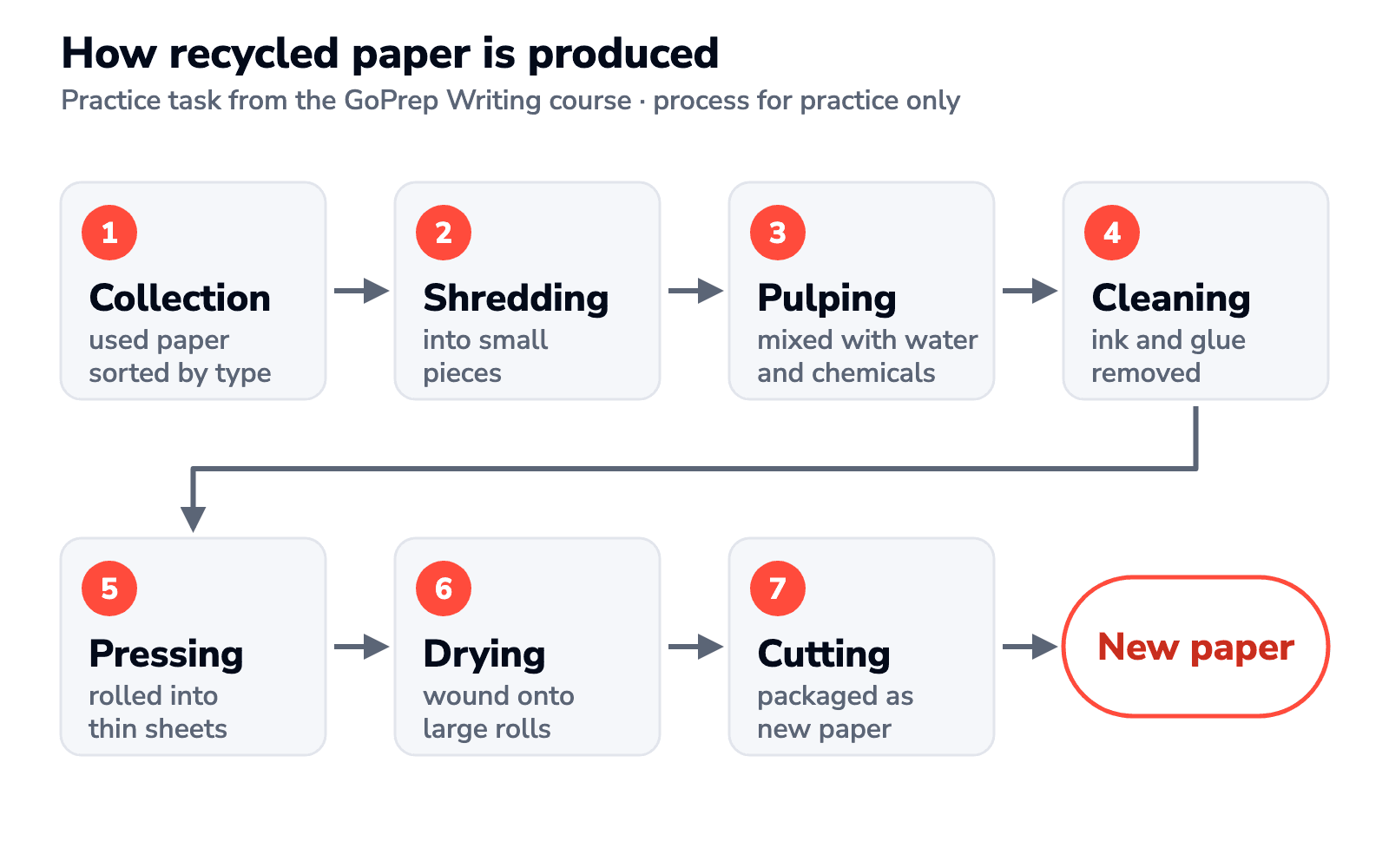
Split where the process changes phase: below, stages 1 to 4 turn old paper into pulp, and stages 5 to 7 turn pulp into new paper. You don't need a conclusion.
How to write the overview for a process
On a line graph, the overview names the main trends over time. A process rarely has trends to summarise: things can grow or heat up inside it, but those are stages. So the overview answers other questions:
- What are the main stages, and how many, if they can be counted clearly?
- Where does the process start and end, or do the arrows form a repeating cycle?
Overviews for all seven chart types, side by side, are in how to write a Task 1 overview.
Weak: trend language where there is no trend
Overall, the amount of paper increases throughout the process.
This diagram shows no quantities, so the sentence describes something that isn't there.
Strong: stages, start and end, plus the two phases
Overall, the process is linear and consists of seven main stages, beginning with the collection of used paper and ending with the cutting and packaging of new paper. The first four stages turn old paper into a clean pulp, while the last three turn this pulp into finished paper.
For a cycle, name the loop: Overall, the diagram shows a natural cycle of four main stages which repeats continuously.
Language for process diagrams: passive voice and sequencing
The present simple passive is is/are + past participle: the pulp is cleaned, the sheets are dried. Sequencing words show the order.
| Job | Useful language | Example |
|---|---|---|
| Start | To begin with, First, The process begins with | To begin with, used paper is collected. |
| Move on | Next, Subsequently, At the next stage, Following this | At the next stage, the pulp is pressed. |
| Link to the stage before | once / after / as soon as + subject + has/have been + past participle (or the present simple) | Once the paper has been sorted, it is shredded. |
| Finish | Finally, In the final stage, The process ends with | Finally, the rolls are cut and packaged. |
What the AI examiner flags in process answers
In its feedback, the GoPrep AI examiner gives a Band Contract: a short list of priority fixes. Here is how often each kind of fix came up, compared with all Task 1 types together.
| Suggested fix | Process answers | All Task 1 types | What to check |
|---|---|---|---|
| Subject-verb agreement | 35% | 33% | the paper is, the sheets are |
| Linking, sequencing and cohesion | 34% | 20% | Linkers chosen by meaning; each stage tied to the one before |
| Passive voice | 33% | 10% (maps: 29%) | is/are + past participle: is shredded, not is shred |
| Articles | 22% | 18% | a/an: one unspecified countable thing; the: it's clear which one |
| Verb tense | 5% | 11% | The present simple as your main tense |
The passive stands out for process: the AI examiner suggested a passive fix in 33% of process answers, against 10% across all Task 1 types together. Maps are also high, at 29%, since they too describe changes people make. Two typical slips (our own examples): The shredded paper are mixed → is mixed; The paper shredded into pieces → is shredded.
Sequence words are rarely missing: only 6% of the 537 first answers had none. What matters is how you use them:
- Link by trigger. Once the metal has melted, it is shaped ties one stage to the last; The metal melts. Then it is shaped reads like a list.
- Refer back. Swap the paper... the paper for it, this pulp, these sheets.
- Choose by meaning. Avoid then in every sentence; repeating a linker that fits is fine.
For articles: a/an introduces a single countable thing the reader doesn't know yet (a machine); the marks one that is clear from the diagram, even at first mention (the machine shown in the diagram). Paper and water as materials usually take no a/an, but in to form a pulp, pulp means the soft mass that results, so a is fine. Keep labels such as pulp or cullet when there is no exact synonym. More words: Task 1 vocabulary guide.
Practice: a full process diagram with a model answer
This task is from the GoPrep Writing course.
The diagram above shows how recycled paper is produced. Summarise the information by selecting and reporting the main features, and make comparisons where relevant.
| Stage | What the diagram shows |
|---|---|
| 1 | Used paper collected and sorted by type |
| 2 | Paper shredded into small pieces |
| 3 | Shredded paper mixed with water and chemicals to form pulp |
| 4 | Pulp cleaned to remove ink and glue |
| 5 | Clean pulp pressed and rolled into thin sheets |
| 6 | Sheets dried and wound onto large rolls |
| 7 | Rolls cut and packaged as new paper |
Fix a weak body paragraph
Here is a weak first body paragraph for this task. We wrote it to show common kinds of fix; it is not a learner's answer.
Then the paper is collect. Then it shredded. Then it mixed with water. Then the pulp is pressed into sheets.
The same part of the process, fixed:
To begin with, used paper is collected and sorted by type. Once it has been sorted, it is shredded and mixed with water and chemicals to form a pulp. This pulp is then cleaned to remove any ink and glue.
| What changed | Weak | Fixed | Criterion |
|---|---|---|---|
| Missing stages | Sorting and cleaning skipped; pressing squeezed in too early | Stages 1 to 4 in full; pressing moves to the next paragraph | Task Achievement |
| Passive forms | is collect, it shredded | is collected, is shredded | Grammatical Range and Accuracy |
| Linking | Then four times | To begin with, once, this pulp | Coherence and Cohesion |
| Accuracy of detail | mixed with water | water and chemicals, ink and glue | Task Achievement |
One paragraph can't prove a band, but these are the edits the band 7 descriptors point to.
Model answer (156 words)
The diagram illustrates the stages by which used paper is recycled to produce new paper.
Overall, the process is linear and consists of seven main stages, beginning with the collection of used paper and ending with the cutting and packaging of new paper. The first four stages turn old paper into a clean pulp, while the last three turn this pulp into finished paper.
To begin with, used paper is collected and sorted according to its type. Once it has been sorted, the paper is shredded into small pieces, which are then mixed with water and a number of chemicals to form a pulp. This pulp is subsequently cleaned so that any remaining ink and glue are removed.
At the next stage, the clean pulp is pressed and rolled out into thin sheets. After that, these sheets are dried and wound onto large rolls. Finally, the rolls are cut to size and packaged as new paper.
Why it works: the overview gives the number of stages, the start, the end and the two phases, with no stage detail. The first body paragraph covers making the pulp and the second turns it into paper; the main actions are passive and in the present, the linkers vary, and this pulp and these sheets refer back instead of repeating the paper.
Practice 2: a process with a loop and a number
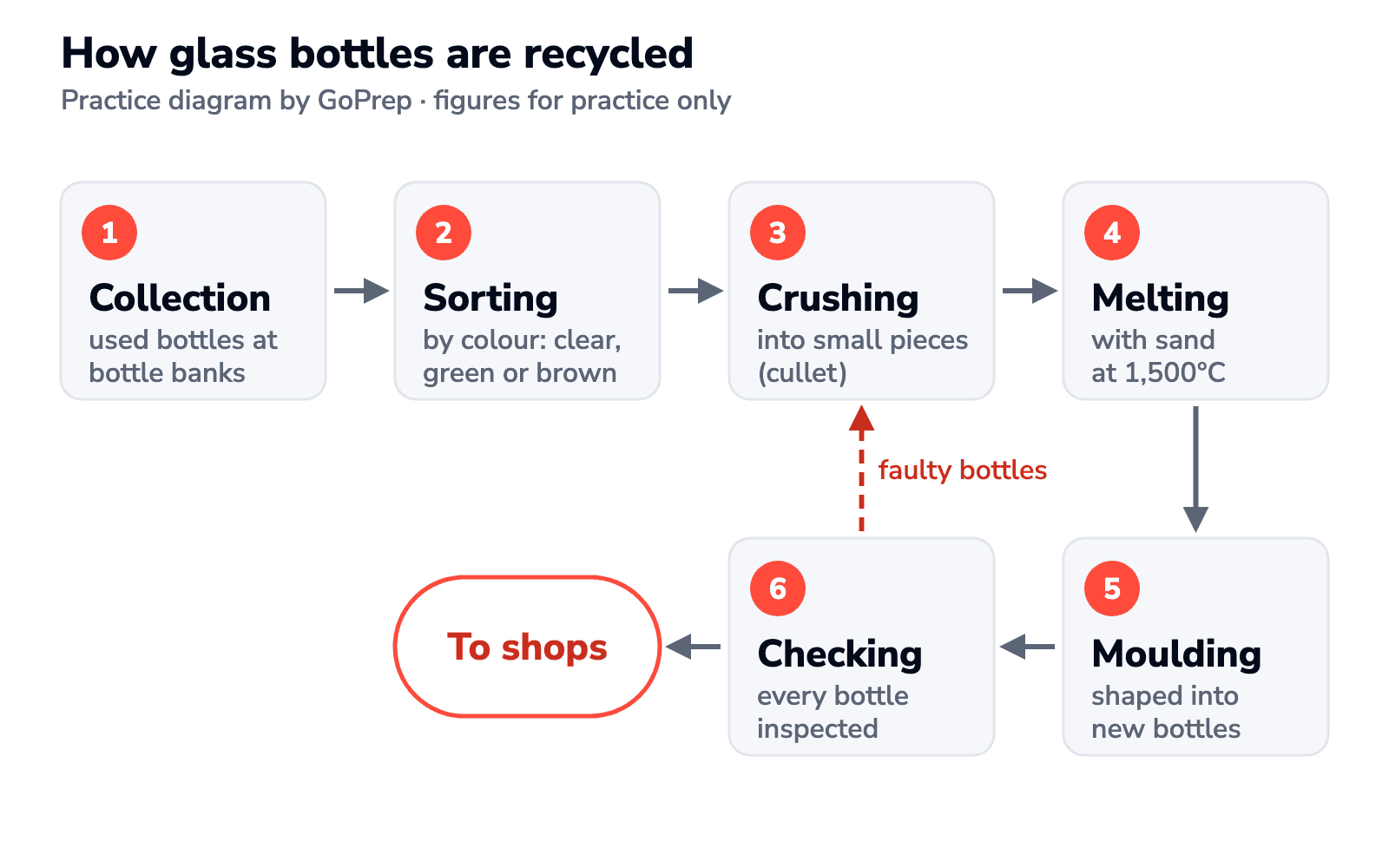
Many exam diagrams are not a straight line. This one sends some bottles back to an earlier stage and gives a temperature. We made the diagram and its figures for practice.
| Stage | What the diagram shows |
|---|---|
| 1 | Used bottles collected at bottle banks |
| 2 | Bottles sorted by colour: clear, green or brown |
| 3 | Glass crushed into small pieces (cullet) |
| 4 | Cullet melted with sand at 1,500°C |
| 5 | Molten glass shaped into new bottles |
| 6 | Every bottle checked; faulty bottles go back to stage 3 |
| End | New bottles sent to shops |
Use while for the two routes after the check. A possible answer:
Overall, used glass bottles pass through six main stages, from collection at bottle banks to the delivery of new bottles to shops, and faulty bottles are returned to an earlier stage.
Once the cullet has been melted with sand at 1,500°C, it is shaped into new bottles. Every bottle is then checked: faulty ones are returned to the crushing stage, while the rest are sent to shops.
What changes compared with a straight line:
- The loop goes into the overview: it is part of how the whole process is organised.
- The number is copied exactly: 1,500°C, not "a high temperature".
- Cullet stays as it is: it is the label on the diagram.
FAQ
Do I need an overview for a process diagram?
Yes. Name the main stages and where the process starts and ends. If the arrows form a cycle, say that it repeats. Keep stage details for the body paragraphs.
Should I use the passive voice in a process diagram?
For man-made processes, usually yes: the present simple passive (the paper is shredded) keeps the focus on the action. For natural processes, the present simple active often sounds better (water evaporates).
What if the diagram shows numbers or a loop?
Include every number exactly as shown: temperatures, times or amounts. Mention a loop in the overview, since it shapes the whole process, and describe it in the body where it happens.
How do I get band 7 on a process diagram?
The band 7 descriptors ask for a clear overview, the key features covered, cohesive devices used flexibly and frequent error-free sentences. For a process, that means every stage in order, an overview of the whole process, linking such as once and this pulp, and accurate passive forms. No single phrase guarantees a band.
Is a process chart the same as a process diagram?
Yes. Both names describe the same Task 1 type: labelled stages joined by arrows. The official IELTS format page calls it a diagram of a process.
Where to practise next
A map also uses the passive, with the tense set by the dates on the maps (the trees were cut down), so it's a natural next type.
Read your report twice: first for passive forms, then for the links between stages. That makes slips easier to spot. Then tell the quiz your target score, exam date and hardest part of IELTS, and GoPrep will build a personal study plan around your answers.

GoPrep Team
GoPrep guide authors
We write about IELTS preparation using platform data and official exam materials.
All articles by GoPrep Team