In a map labelling task, you hear someone describe a place and match what they say to a map, plan or diagram in the test. ielts.org calls it plan/map/diagram labelling and says the task tests whether you can "understand explanations of where things are and follow directions (e.g. straight on/through the far door)".
The short version of the method: before the recording starts, find where the speaker begins and which way they are facing. Then follow them one place at a time, in order.
Why a method? In GoPrep Listening mocks, Part 2 map questions went wrong more often than the rest of Part 2 at every score level.
How map labelling works in IELTS Listening
The official description, from the ielts.org Listening format page:
- the visual may be "a diagram (e.g. a piece of equipment)", "a set of pictures", "a plan (e.g. of a building)" or "a map (e.g. of part of a town)";
- "You have to select your answers from a list";
- the number of questions is "Variable".
Which part? IDP calls map labelling "a common task type for Section 2". That fits the official description of Part 2: "only one main speaker" in an everyday situation, "for example, a speech about local facilities". The task can appear in other parts too. Of the 77 different full Listening mocks GoPrep students took from 28 August to 26 September 2026, 28 had a map, plan or diagram set, and 26 of those 28 had it in Part 2.
Letters or words? ielts.org describes choosing from a list. IDP describes two kinds of map task: one where you "select options from a list (e.g. A – G)" and one where "you have to use words directly from the recording". In the same 28 mocks, 140 of the 162 map questions (86%) took a letter.
| Form | What you see | What you write |
|---|---|---|
| Choose from a list | Letters (A, B, C…) on the map and a list of places to label | One letter per question, exactly as the instruction asks |
| Write the words | Empty labels on the map and a word limit, such as NO MORE THAN TWO WORDS | Words you hear, inside the limit and spelled correctly |
For the word form, two rules cost marks: "You will lose the mark for writing more than the word limit" (ielts.org), and a misspelled word is marked wrong (IDP). Our guide to IELTS Listening spelling covers the words people misspell most.
A 5-step method for map labelling
- Read the instruction. Letter or words? If words, what is the limit?
- Find the start, then confirm it. Look for a marked entrance or "You are here" and check the north arrow. When the recording begins, listen for where the speaker stands and which way they face.
- Read the landmarks. Places already labelled on the map are the ones the speaker will use: the car park, the reception, the lake. Say each one in your head so you recognise it when you hear it.
- Listen to the whole description. Choose the place that matches all the clues, and check whether the speaker means where something is now, where it used to be or where it will be. IDP advises you to "listen to everything the speaker says and not just write down the first thing or place that you hear".
- Keep up with the questions. If you lose your place, wait for the next landmark the speaker names and continue from there. At the end, fill every empty question with your best guess: a blank answer will get no marks.
The word you hear may not be the label. For Café, you might hear: "If you want a coffee, try the building across the path from the visitor centre." There is no café and no opposite: coffee points to the place and across the path from gives its position. And the last place named is not always the answer. In "The café is opposite the library, not beside the gate", the gate is the place to reject.
Direction and position phrases
This is the language that carries the answer. IDP lists many of these phrases; the right-hand column shows how each one catches people.
| Phrase | What it means on the map | Watch out |
|---|---|---|
| opposite, across from | On the other side of a road, path or room, facing it | Find the road or path first, then cross it |
| next to, beside, adjacent to | Right by it, with nothing in between | Adjacent to means next to, not somewhere near |
| between X and Y | X on one side, Y on the other | Find both X and Y before you choose |
| at the far end (of) | The end furthest from the speaker | Far from the speaker, not the top of the map |
| just past | A short distance after a landmark | Depends on which way the speaker is walking |
| beyond | Further than a landmark, distance not given | Could be close or far: use the other clues |
| on the corner of | Where two roads or corridors meet | A junction may have several corners: use the other clues |
| in the north-east corner | Top right, if north is at the top | Check the north arrow first |
| in the north of vs to the north of | Inside the area vs outside it, further north | One small word moves the place |
| behind | On the far side of it from the speaker or the path | Ask: behind from where? |
| facing, overlooking | Its front or view points at something | Two similar buildings: only one overlooks the harbour |
| on your left, on your right | From the speaker's position and direction | Matches the map only if they face its top |
| clockwise, anticlockwise | Round a path the way a clock's hands move, or the other way | From the bottom of a circle, clockwise goes left first |
The in the north of vs to the north of difference also matters in Writing: see how it works in the IELTS map task in Writing Task 1.
Whose left and whose right?
Most people read a map with north at the top and themselves at the bottom. Speakers don't always stand there. IDP warns that "sometimes the speaker will say where they are standing and which direction they are looking", and that they "may return to this starting point for the subsequent questions, not just the first one".
When the speaker faces the top of the map, their left is the left of the map. In every other direction, left and right move. The start may be marked on the map or given only in the recording, so confirm it when the speaker begins, and update the direction after every turn.
| The speaker faces | Their left is | Their right is |
|---|---|---|
| The top of the map (north) | The left of the map (west) | The right of the map (east) |
| The bottom of the map (south) | The right of the map (east) | The left of the map (west) |
| The right of the map (east) | The top of the map (north) | The bottom of the map (south) |
| The left of the map (west) | The bottom of the map (south) | The top of the map (north) |
Compass words don't move: north stays north wherever the speaker stands. Not every map has a north arrow, and IDP notes that without one the speaker may use left and right instead.
How often map questions go wrong
We checked 284,440 answers from 7,111 finished full GoPrep Listening mocks (2,615 students, 28 August to 26 September 2026) and compared question types. Finished means a score above 0 and at least one non-empty answer in every part, so abandoned tests don't count. Not correct includes blanks.
| Question type | Not correct | Left blank |
|---|---|---|
| Short answer | 64% | 15% |
| Table completion | 49% | 8% |
| Map, plan and diagram labelling | 43% | 2% |
| Sentence, form and note completion | 43% | 9% |
| Matching | 38% | 1% |
| Multiple choice, one answer | 34% | <1% |
| Multiple choice, two or more answers | 31% | <1% |
| All Listening questions | 41% | 5% |
On the whole test, maps look close to average: 43% not correct, against 41% for all Listening questions together. Very few map answers were left blank, 2% against 5% overall, and most of them are a letter from a list.
The average hides where maps sit. GoPrep stores maps, plans and diagrams as one question type, so these figures cover all three. Below, we take only the Part 2 map sets and compare them with the other Part 2 questions of the same 2,451 finished mocks, split by the test taker's score in that mock.
| Score in the mock | Part 2 map questions | Rest of Part 2 |
|---|---|---|
| 0–17 (below 5.5) | 69% | 60% |
| 18–22 (band 5.5) | 52% | 39% |
| 23–25 (band 6) | 43% | 30% |
| 26–29 (band 6.5) | 35% | 21% |
| 30–34 (band 7–7.5) | 22% | 14% |
| 35–40 (band 8+) | 11% | 5% |
| All | 43% | 33% |
The gap is widest in the middle: from 18 to 29 correct answers (band 5.5 to 6.5), map questions went wrong 13 to 14 percentage points more often than the rest of Part 2. This shows where marks go, not why. For the correct answers each band needs, see the IELTS Listening band score table.
Letters vs words. Word-answer map questions were left blank more often: 8% against 2% for letter answers, with 46% and 43% not correct (1,362 and 12,371 answers, from only 5 tests with word answers).
Which questions in a map set go wrong
We looked at 12,891 answers in map sets of 4 to 6 questions (2,421 finished mocks):
- first question in the set: 32% not correct;
- questions in the middle: 49% not correct;
- last question: 33% not correct.
Blanks stay low throughout: 1%, 2% and 1%. In these sets, middle questions had a higher error rate than the first and last ones. This does not tell us whether test takers lost their place or whether those questions were harder.
Misses also came in pairs. Among test takers with 23 to 29 correct answers, after a wrong map answer the next map question was wrong 53% of the time; after a correct one, 32% (3,345 pairs of neighbouring questions). The same pattern held at lower and higher scores. Still, 47% got the next question right straight after a miss, so one wrong answer does not decide the rest of the set.
Practice: label the Hollin Park map
This map and tour were written for this guide; the park is invented. You will need 5 minutes.
- Look at the map for 30 seconds and do steps 1 to 3 above.
- Ask a friend to read the tour script aloud once, or read it once yourself and cover it.
- Write a letter, A to H, for questions 11 to 15. Five of the eight letters are answers.
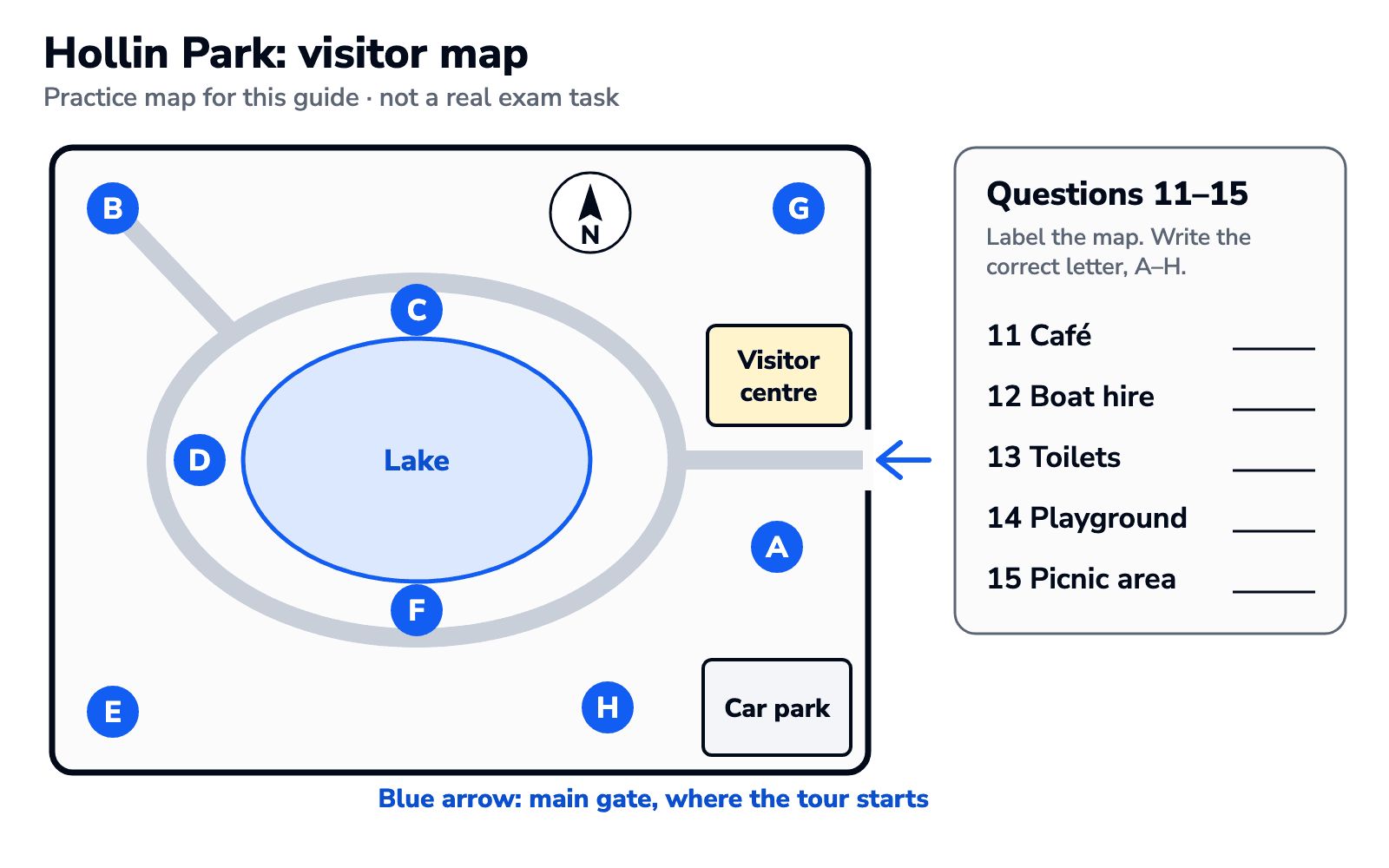
| On the map | Where it is | Role in the task |
|---|---|---|
| North arrow | Points to the top of the map | Direction |
| Main gate | Middle of the east (right) side. The tour starts here | Starting point |
| Main path | Runs west from the gate to a path that goes round the lake | Route |
| Visitor centre | Next to the gate, north of the main path | Landmark |
| Car park | South-east corner | Landmark |
| A | Next to the gate, south of the main path | Answer option |
| B | North-west corner, at the end of a path from the lake path | Answer option |
| C | North shore of the lake | Answer option |
| D | West shore of the lake | Answer option |
| E | South-west corner | Answer option |
| F | South shore of the lake | Answer option |
| G | North-east corner, north of the visitor centre | Answer option |
| H | Just west of the car park | Answer option |
Tour script
Good morning, and welcome to Hollin Park. We're standing at the main gate, looking along the path towards the lake.
First, refreshments. The café used to be inside the visitor centre, which is the building here on your right. But it moved last spring, and it's now directly opposite the visitor centre, on the other side of this path.
If you'd like to go out on the water, follow this path straight ahead to the lake. You can't hire a boat on this side, I'm afraid. Boat hire is at the far end of the lake, so walk round to the shore furthest from where we're standing.
You may notice a sign for toilets next to the car park. Those have closed, so please don't go there. The toilets are now in the north-east corner of the park, just north of the visitor centre.
Families, the playground is well worth a visit. When you reach the lake, take the path to the right. You'll pass the bird hide on the north shore, on your left. Then leave the lake path and keep going beyond the lake into the corner.
Finally, the picnic area. It isn't in the south-west corner, which is for staff only. You'll find it on the south shore of the lake, right by the water.
| Question | Answer | How you know |
|---|---|---|
| 11 Café | A | "Directly opposite the visitor centre, on the other side of this path." The visitor centre is where it used to be |
| 12 Boat hire | D | "The far end of the lake… furthest from where we're standing." You start in the east, so that is the west shore, not the top (C) |
| 13 Toilets | G | "In the north-east corner… just north of the visitor centre." The toilets by the car park (H) have closed |
| 14 Playground | B | Facing west, right is north. Go along the north shore, then take the path to the corner beyond the lake: north-west |
| 15 Picnic area | F | "The south shore of the lake." The south-west corner (E) is for staff only |
If you wrote C for question 12, check whether you read far end as top of the map. If you chose a southern place for question 14, check whether you turned south instead of north when you reached the lake from the gate.
Map sets are a handful of marks in one part, and your band comes from all 40 answers. Here is how GoPrep students' whole Listening scores moved across their mock tests:
FAQ
Which part of IELTS Listening has map labelling?
Map labelling is most common in Part 2, where one main speaker talks about an everyday place, such as a tour of a park or a building. It can also appear in other parts of the test.
Does IELTS General Training have map questions in Listening?
Yes, it can. The Listening test is the same for IELTS Academic and General Training, so the same question types, including plan, map and diagram labelling, appear in both.
Do I write the letter or the name of the place?
Follow the instruction. If it asks for the correct letter, write the letter. If it asks for words, write words from the recording, within the word limit and spelled correctly: going over the limit loses the mark.
What should I do if I miss an answer on the map?
Move on to the next question at once: the questions follow the order of the recording. Continue from the next place the speaker names, and fill the missed question with your best guess at the end, since a blank gets no marks.
What to practise next
For the other question types around a map set, see our guides to Listening multiple choice and form and note completion, and for the whole test, our IELTS Listening tips.
Tell the quiz your target score, exam date and the IELTS skill you find hardest, and GoPrep will build a personal study plan from your answers.
P.S. The full map, plan and diagram lesson, with more practice routes, is in the GoPrep course.

GoPrep Team
GoPrep guide authors
We write about IELTS preparation using platform data and official exam materials.
All articles by GoPrep Team