Take IELTS Academic if you are applying to a university for a bachelor's or master's degree, or for professional registration, for example as a doctor or nurse. Take IELTS General Training if you are migrating to an English-speaking country, going abroad for work experience or training, or studying below degree level. That is how ielts.org splits the two tests (checked 29 September 2026).
One condition: the organisation you apply to decides, not you. So this guide starts from your goal, then shows what really differs between the tests.
Which IELTS test do you need?
| Your goal | Book this test | What the official page says |
|---|---|---|
| Bachelor's or master's degree | Academic | ielts.org: choose it "if you wish to study at undergraduate or postgraduate levels" |
| Professional registration, e.g. doctor or nurse | Academic | ielts.org names "doctors and nurses". The UK nursing regulator NMC accepts IELTS Academic and says a test "must not be a general test" |
| Canada: permanent residence through Express Entry | General Training | IRCC: "You must take the IELTS General Training option" |
| Australia: a visa that asks for English | Academic or General Training | Home Affairs lists both, taken at a test centre. Check your visa subclass for the score |
| UK visa or citizenship that needs a secure English test (SELT) | IELTS for UKVI (Academic or General Training) or IELTS for UKVI Life Skills, depending on the route | gov.uk accepts "'IELTS for UKVI' or 'IELTS Life Skills'". Routes are below |
| Work experience, training, school or college below degree level | General Training | ielts.org: for those who "wish to train or study at below degree level" |
Two things follow from this table:
- Get the exact test name in writing: "IELTS Academic", "IELTS General Training" or "IELTS for UKVI". If the page is unclear, use the message below.
- Online is for Academic only. IELTS Online means taking the test at home, not the computer test at a centre. ielts.org offers Academic "at a test centre or remotely online" (where available) and General Training "at a test centre". Australia's Home Affairs and the NMC don't accept IELTS Online.
If the organisation accepts other English tests too, compare them in IELTS vs TOEFL vs Duolingo.
When your plan has two goals
Check both requirements before you book, then see whether one result can cover both.
- A nurse moving to the UK. Check the NMC, which accepts IELTS Academic, and the Health and Care Worker visa. One result may be enough: gov.uk says doctors, dentists, nurses and midwives "do not need to prove" their English for this visa "if you've already passed an English Language assessment that is accepted by the relevant regulated professional body".
- A degree now, Canadian permanent residence later. Check the university's page and IRCC. IRCC accepts only General Training for Express Entry, with results "less than 2 years old" both when you complete your profile and when you submit your application. One result is enough only if the university accepts General Training and the result is still under 2 years old at both points. Otherwise, plan two tests.
- An organisation that accepts both: study, then a visa in Australia. Check the university's page and the Home Affairs page for your visa subclass. Home Affairs accepts both modules taken at a test centre, so your Academic result can also count for the visa if it meets the visa's score and age limit. For competent English, that means a result "in the 3 years before your visa application, depending on the visa subclass".
Your final choice card
Before you pay, write down six lines for each organisation you apply to:
- The organisation and the page you checked.
- The exact test name.
- Delivery: test centre, UKVI centre or online, and whether One Skill Retake counts.
- The overall band.
- The minimum for each skill.
- How old the result may be, and on which date it is checked.
Here is the card filled in for the nurse above:
| Line | NMC (nursing register) | Health and Care Worker visa |
|---|---|---|
| Page | NMC: IELTS Academic | gov.uk: knowledge of English |
| Test name | IELTS Academic (IELTS Academic UKVI also accepted) | No separate test if the NMC accepted yours; otherwise IELTS for UKVI |
| Delivery | Test centre; no IELTS Online, no One Skill Retake | UKVI centre, in person |
| Overall | Not set | Not set |
| Each skill | 7 in Listening, Reading, Speaking; 6.5 in Writing | B2: 5.5 in each part for IELTS for UKVI |
| Result age | Taken in the 2 years before the NMC assesses your full application | SELT results are valid for 2 years |
Result: one IELTS Academic or IELTS Academic UKVI at a test centre, with the NMC scores, can cover both goals.
If the page just says "IELTS"
Some university pages only say "IELTS 6.5". Don't guess the module: ask the admissions office and keep the answer. A message you can copy:
Dear Admissions Team,
I am applying to [programme], starting [month and year]. Your English requirements page says "IELTS". Could you please confirm:
- whether you accept only IELTS Academic, or also IELTS General Training;
- whether standard IELTS is enough, or I need IELTS for UKVI;
- whether you accept IELTS Online, taken at home;
- the minimum overall band and the minimum for each skill.
Thank you, [Your name]
A pattern worth checking: bachelor's goal, General Training module
Among GoPrep learners who joined between 19 and 26 September 2026 with a bachelor's degree as their goal, 87% had chosen a module, and 15% of them chose General Training (462 of 3,133). In Kazakhstan it was 11% (30 of 284, with 90% of the group having chosen a module), in Uzbekistan 18% (98 of 551, 87%). Country here means the time zone on the learner's profile.
This is not necessarily a mistake. ielts.org lists study "below degree level", such as some foundation or college courses, under General Training. But for a bachelor's or master's degree it points to Academic. If that's you, check the programme's page before you book.
What is the same and what is different
ielts.org sums it up: "In both the General Training and the Academic tests, the Speaking and Listening sections are the same. However, the Reading and Writing sections of these tests differ." The timings match too: Listening about 30 minutes, Reading 60, Writing 60 and Speaking 11 to 14 minutes. Both tests use the same 1 to 9 band scale.
| Part | Academic | General Training |
|---|---|---|
| Listening | Same test | Same test |
| Speaking | Same test | Same test |
| Reading texts | Books, journals, magazines, newspapers | Notices, ads, timetables, then work texts, then one longer text |
| Reading length | 3 sections, 2,150 to 2,750 words | 3 sections, 2,150 to 2,375 words |
| Writing Task 1 | Describe a graph, table, chart or diagram | Write a letter: personal, semi-formal or formal |
| Writing Task 2 | Essay, academic or semi-formal/neutral style | Essay, semi-formal/neutral style |
| Where you take it | Test centre or online | Test centre |
Reading: different texts, same 40 questions
Both modules use a range of question types. The main differences are the texts and how correct answers convert to a band.
Academic texts come from "books, journals, magazines, newspapers and online resources, written for a non-specialist audience", and at least one has "detailed logical argument" (ielts.org). General Training moves from daily life to work (ielts.org): notices, advertisements and timetables in Section 1, "job descriptions, contracts, staff development and training materials" in Section 2, and one longer text of general interest in Section 3.
Writing Task 1: the biggest difference
Task 1 needs different preparation in the two modules. Both need at least 150 words in about 20 minutes, but the job is different:
- Academic: you "describe some visual information in your own words (a graph, table, chart or diagram)" (ielts.org). You need an overview of the main features: compare figures in a chart, describe changes on a map, pick out the main stages of a process. Start with our line graph guide.
- General Training: you write a letter, and "the task tells you what information to include in the form of three bullet points" (ielts.org). You need to cover all three points in a tone that fits the reader, from a friend to a manager. Start with our General Training letter guide.
Two short tasks we wrote for this guide show the difference. First, an Academic chart:
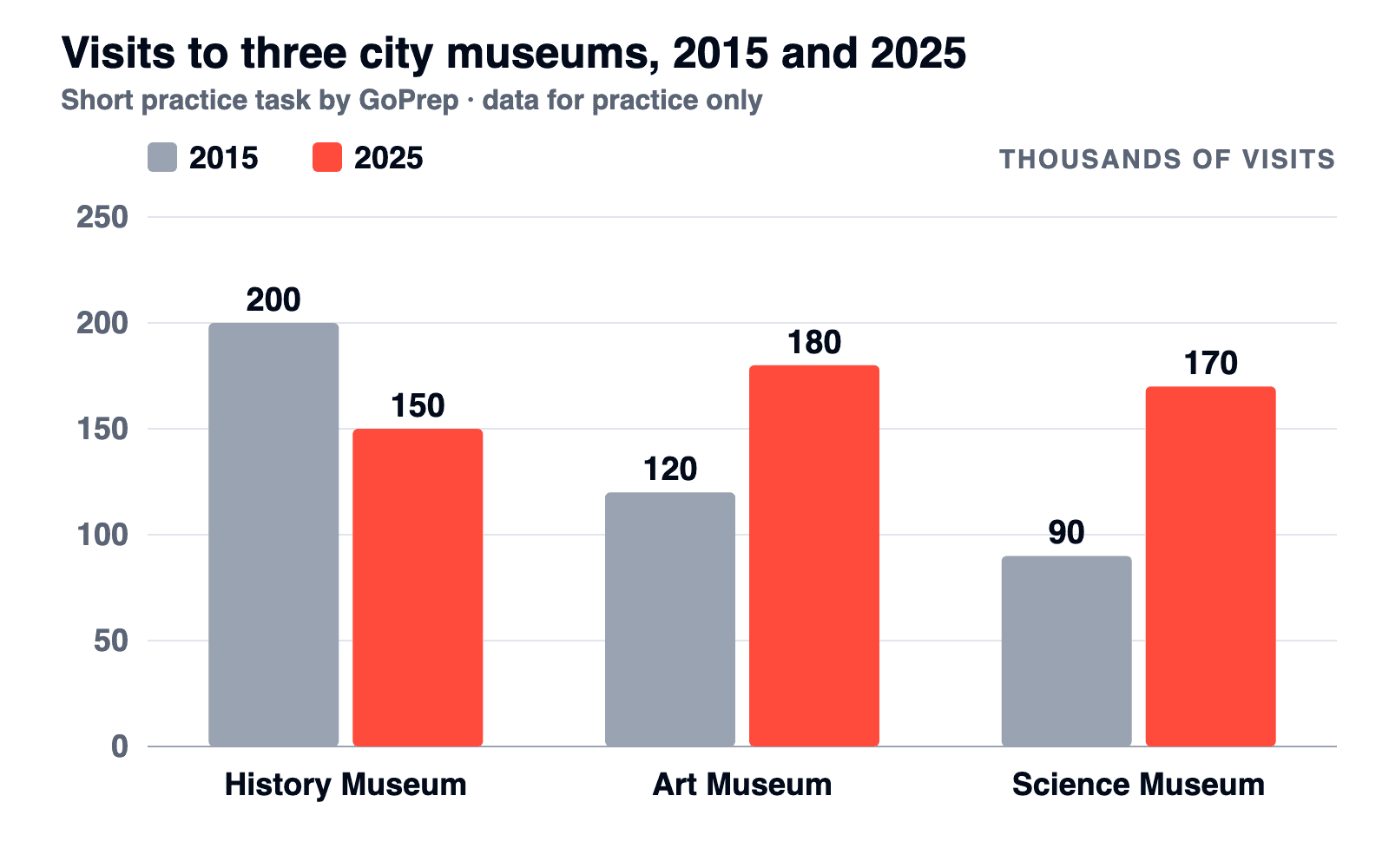
| Museum | 2015 | 2025 |
|---|---|---|
| History Museum | 200 | 150 |
| Art Museum | 120 | 180 |
| Science Museum | 90 | 170 |
A good overview opening: "Overall, the History Museum lost visitors while the other two gained, and by 2025 the Art Museum had become the most visited of the three." No numbers and no opinion yet: just the main trend and the ranking.
Now a General Training letter:
You recently stayed at a hotel and left a bag in your room. Write a letter to the hotel manager. In your letter:
- describe the bag and what was in it
- explain when and where you left it
- say how you would like to get it back
A fitting opening: "Dear Sir or Madam, I stayed in Room 214 at your hotel from 3 to 5 March, and I am writing because I left a small black backpack in the room when I checked out." The first sentence says who you are and why you are writing, in a formal tone for a manager you don't know. The body then answers the three bullet points. Academic Task 1 tests selecting and comparing information; General Training Task 1 tests writing for a purpose and a reader.
Writing Task 2: one essay, a slightly different register
Task 2 is the same kind of essay in both tests: at least 250 words in about 40 minutes, counting twice as much as Task 1. ielts.org asks for "an academic or semi-formal/neutral style" in Academic and "a semi-formal/neutral discursive essay" in General Training. Our Writing Task 2 guide works for both.
Is General Training easier than Academic?
Don't treat General Training as an easier way to your band. Listening and Speaking are the same, Writing uses the same four criteria, and General Training Reading usually needs more correct answers. ielts.org says: "It is usual that a greater number of questions must be answered correctly on a General Training Reading test to secure a given band score." Here are the average marks it publishes for each band:
| Correct answers out of 40 | Academic Reading | General Training Reading |
|---|---|---|
| 15 | Band 5 | Band 4 |
| 23 | Band 6 | Band 5 |
| 30 | Band 7 | Band 6 |
| 35 | Band 8 | Band 7 |
The same 30 correct answers are about band 7 in Academic and band 6 in General Training. The reason ielts.org gives: the Academic test "may contain texts which feature more difficult vocabulary or greater complexity of style". So General Training texts are more often about daily life and work, but the conversion is stricter. Full band tables for both tests are in our Reading band score guide.
If you need band 7 in General Training Reading, aim for about 34 to 35 correct answers in practice, not 30.
Which module do GoPrep learners prepare for?
Among learners who joined GoPrep between 28 July and 26 September 2026 and chose a module:
- Uzbekistan: 71% prepare for Academic (1,186 of 1,673).
- Kazakhstan: 83% prepare for Academic (733 of 888).
Country means the profile time zone, not citizenship. About 9 in 10 of these learners signed up between 19 and 26 September; among those who joined earlier, fewer than 1 in 100 have a module in their profile.
Split by goal, across all GoPrep learners in the same period, the picture looks like this:
| Goal the learner chose | Academic | General Training |
|---|---|---|
| Bachelor's degree (3,331 learners) | 86% | 14% |
| Master's degree (1,884 learners) | 85% | 15% |
| Career (2,544 learners) | 49% | 51% |
Learners with a career goal chose the two modules almost equally: a career move can mean professional registration (Academic) or a work visa, where the rule depends on the country. The table shows what learners chose, not what their organisations require.
IELTS for UKVI: both modules have a UKVI version
Some UK visas need a Secure English Language Test (SELT). For IELTS, that means "'IELTS for UKVI' or 'IELTS Life Skills'". It exists for both modules, and the British Council says these versions are "the same design, format and difficulty as standard IELTS tests". What changes is how you take it: "The UKVI will only accept tests taken in person at an official IELTS for UKVI test centre" (ielts.org).
Rules for people who prove their English with an IELTS test (ielts.org and gov.uk, checked 29 September 2026). Some applicants can use another proof, such as a degree taught in English:
- Skilled Worker and Health and Care Worker visas, new application: level B2, which for IELTS for UKVI means at least 5.5 in each of the four parts. Extending a visa you had before 8 January 2026: B1, and you "do not need to prove your knowledge of English again". Doctors, nurses and some other regulated professions can use an assessment their regulator accepted (gov.uk).
- Student visa below degree level: IELTS for UKVI, at least 4.0 in each part.
- Student visa at degree level or above: level B2, which ielts.org gives as "IELTS or IELTS for UKVI" with at least 5.5 in each part. Gov.uk adds that the university "can assess your level of English themselves", and the university sets its own band for admission.
- Settlement and British citizenship: IELTS for UKVI Life Skills B1, which tests only Listening and Speaking.
Which UKVI version fits your route, and the full rules: IELTS for UKVI guide.
Does General Training cost less?
No. In Kazakhstan and Uzbekistan, Academic and General Training cost the same with each provider. You choose the module when you book, so decide before you pay.
| Test on computer | Kazakhstan, KZT | Uzbekistan, UZS |
|---|---|---|
| Academic or General Training | 110,250 (IDP and British Council) | 2,665,000 (IDP), 2,798,000 (British Council) |
| IELTS for UKVI, Academic or General Training | 123,000 (IDP and British Council) | 3,119,000 (British Council) |
Check the fee on the booking page on the day you pay. Centres and booking steps: IELTS in Kazakhstan and IELTS registration in Uzbekistan.
Practice: Academic, General Training or either?
Here are three tasks described in IELTS style. Decide which test each one could come from before you read the answers.
- A journal article about memory in bilingual children, with a table of test results, followed by questions on the researchers' findings.
- A one-page notice from a company about new staff parking rules, followed by questions on which employees may use each car park.
- Some people think governments should spend more on public transport than on roads. To what extent do you agree or disagree?
Answers
- Academic. ielts.org lists journals as a source only for Academic Reading, and Academic texts "may also contain diagrams, graphs or illustrations".
- General Training. Work texts such as staff rules are what ielts.org describes for General Training Reading Section 2.
- Either. Task 2 is an essay in both tests; only the style requirement differs a little.
Check yourself: which test would you book?
FAQ
Is IELTS General Training easier than Academic?
Don't treat it as an easier way to get the band you need. Listening and Speaking are the same, Writing is marked on the same criteria, and General Training Reading usually needs more correct answers for the same band: 30 out of 40 is about band 7 in Academic and band 6 in General Training.
Can I use IELTS Academic for immigration?
It depends on the country. Australia's Home Affairs accepts both Academic and General Training taken at a test centre, but Canada's Express Entry accepts only General Training, and many UK visas need IELTS for UKVI. Check the page of your visa before you book.
Can I take IELTS General Training online?
No. ielts.org says General Training is taken at a test centre, while Academic can be taken at a centre or online. Some organisations, including Australia's Home Affairs and the UK's NMC, do not accept IELTS Online.
Next step
Before you book, fill in the choice card for each organisation. Three lines decide the booking:
- the exact test name;
- the overall band;
- the minimum for each skill.
Then check how your overall band is calculated. For Reading and Writing Task 1, practise with materials for your module. Split your time by your mock results and the minimum for each skill, and remember that Task 2 counts twice as much as Task 1 in Writing. Then follow a first-week IELTS preparation plan.

GoPrep Team
GoPrep guide authors
We write about IELTS preparation using platform data and official exam materials.
All articles by GoPrep Team