In IELTS Reading note, table, flow-chart and diagram completion, you fill gaps in a short outline of part of the passage with words taken from the passage. Notes, a table and a flow-chart are one official task type; ielts.org calls it summary/note/table/flow chart completion. Diagram label completion is a separate type that works the same way, but on a picture.
Four rules decide the mark:
- Copy, don't invent. The answer is a word or words from the passage, unless the task gives you a list to choose from.
- Obey the word limit. "You will lose the mark for writing more than the word limit", says ielts.org.
- Don't expect text order. The answers "may not come in the same order as in the text", but they "will usually come from one part of the text".
- Spell it exactly. A misspelled answer is marked as incorrect.
In GoPrep mocks, blank gaps were 53% of the marks lost on these tasks below band 5. From band 5.0, extra words, a missing word, a wrong -s ending and possible spelling errors flagged by our check together were under 1 in 10 lost marks. So the method is: find the one part of the passage the outline retells, then the exact word each gap needs.
How the four layouts work
The layout changes how you read the task, not what you write. In every layout you write words from the passage, or a letter if you choose from a list.
| Layout | What it looks like | What helps you |
|---|---|---|
| Notes | Short lines under a heading, often with dashes | The heading tells you which part of the passage to read |
| Table | Rows and columns, some cells empty | Column and row titles tell you the kind of word: a date, a price, a material |
| Flow-chart | Boxes joined by arrows, showing the steps of a process | Words like then, after that and finally in the passage mark each step |
| Diagram labels | A picture of a machine, building or process with numbered labels | The position of each label on the picture, not its number |
The official Reading format page adds three details worth knowing:
- In the completion task there are "two variations": you either "select words from the text" or "choose from a list of words". With a list, you choose from the options instead of copying from the passage, so read the instruction first.
- The outline covers part of the passage: "the summary is not normally of the whole text".
- "Hyphenated words such as 'check-in' count as single words", and "contracted words such as 'they're' will not be tested".
Each correct answer gets 1 mark, and a wrong answer loses nothing extra, so fill every gap.
Which completion questions go wrong most
We compared question types in 6,750 full GoPrep Reading mocks taken by 2,681 students from 12 September to 11 October 2026, counting every attempt. The completion rows include only gaps where the answer is a word or number; the last row includes every Reading question, letter answers too. Not correct includes blanks.
| Question type | Answers | Not correct | Left blank |
|---|---|---|---|
| Table completion (including note-style tables) | 31,751 | 37% | 13% |
| Flow-chart completion | 684 | 47% | 28% |
| Diagram label completion | 1,126 | 51% | 18% |
| Summary completion | 33,342 | 52% | 32% |
| Sentence completion | 13,551 | 55% | 27% |
| All Reading questions | 270,000 | 50% | 20% |
Table completion went wrong less often than the average Reading question, while flow-charts and diagrams sat close to the average. Flow-chart and diagram figures come from fewer tests (6 and 13 test versions, against 35 with tables), so a single hard test moves them more.
Where do the lost marks go? We sorted every table, flow-chart and diagram answer that scored 0, split by the band of the whole mock:
| What the answer was | Band below 5.0 | Band 5.0 and above |
|---|---|---|
| Left blank | 53% | 13% |
| An accepted answer plus extra words | Under 1% | Under 1% |
| An accepted answer with a word missing | Under 1% | 1% |
| Right word, but -s or -es added or missing | 1% | 4% |
| Possible spelling error found by a simple check* | 1% | 4% |
| The answer to another gap in the same set | 2% | 3% |
| Other answers not classified by these checks | 43% | 75% |
*Same first three letters and within two letters of the answer's length, for one-word answers of 5 letters or more.
Two things stand out:
- Below band 5, half of the lost marks are empty gaps. A blank can't score. A word copied from the right part of the passage sometimes does.
- From band 5 up, the checks we could run cover few lost marks. Extra words, a missing word, a wrong -s ending and possible misspellings together were under 1 in 10. Three in four lost answers were not explained by any of these checks.
These checks don't tell us why a student wrote a wrong answer, and the word limit of each task isn't stored, so we couldn't count answers over the limit. What the table does show: below band 5, filling every gap is the first job. At band 5.0 and above, 75% of lost marks remained unclassified by these checks, and the data doesn't establish their causes. The method below focuses on finding the right part of the passage and the right word inside it.
How to answer completion questions in 5 steps
- Read the instruction and note the limit. ONE WORD ONLY, NO MORE THAN TWO WORDS, ONE WORD AND/OR A NUMBER: each one changes what you may write. Check whether you copy from the passage or choose from a list.
- Read the outline as a whole. Read the title, the column and row headings, or the arrows of the flow-chart. Then say in a few words what this part of the passage is about.
- Predict each gap. Decide what kind of word fits: a noun, a verb, a number, a plural. Up to ___ litres needs a number. A layer of ___ needs a noun.
- Find the zone, then the word. Scan for a name, number or heading word from the outline to find the part of the passage it retells. Inside that zone, match meaning, not the same words: the outline almost always paraphrases (says it in other words).
- Copy or choose, then check. For answers taken from the passage, copy the word exactly as it is spelled. For a word list, choose the option that matches the meaning and the grammar of the gap. Read the line back with your answer in it: is it grammatical, inside the limit, and does it repeat a word already printed next to the gap?
Tables and flow-charts: use the layout
In a table, the headings do half the work. If the column says Year, the gap is a date; if the other cells in the row say wood and glass, the answer is a material. The answers can jump around the zone, so don't stop after one match.
In a flow-chart, each box is a step. The passage marks steps with time words (first, then, once, after that, finally) and with verbs of change (is heated, is pressed, dries). If the box reads The leaves are ___, you need a verb form such as rolled, not a noun.
Diagram labels: work from the picture
A diagram shows where parts are, and the passage may describe them in a different order. Label 1 at the top of a machine may be described last. So:
- find where the passage describes the machine or process, and read that part, including nearby paragraphs, for the labels;
- read each description and ask where on the picture it is (at the base, above the filter, along the edge);
- write the answer next to the number at that place, not the next number in the list.
Practice: a table, a flow-chart and a diagram
We wrote this passage for the guide; the town of Calvera is invented. Give yourself 8 minutes and write your answers before you read the key.
Water from the fog
On the dry coast near the town of Calvera, it almost never rains, but on most mornings a thick fog rolls in from the sea. Since 2015, the town has collected drinking water from this fog with a simple device called a fog collector.
A collector is a fine plastic mesh, about 4 metres high and 10 metres wide, stretched between two wooden poles and turned to face the wind. As fog drifts through the mesh, tiny droplets stick to the threads. They join into larger drops, which roll down into a gutter running along the bottom edge. From the gutter, a pipe carries the water downhill to a storage tank. Before anyone drinks it, the water passes through a sand filter beside the tank.
The amount collected depends on the season. In winter, when the fog is thickest, one collector can produce 200 litres on a good day; in summer the figure can fall below 20 litres. The town's 30 collectors supply a school and about 80 homes.
The project has had problems. Strong winds tore the first meshes within months, so the frame is now held in place by steel cables fixed to the ground. Birds also perched on the top rope and damaged the mesh, which was solved by adding a row of thin wires above it.
Questions 1-8. Choose ONE WORD AND/OR A NUMBER from the passage for each answer.
| Fog collectors in Calvera | Detail |
|---|---|
| Where the fog comes from | the 1 ______ |
| Size of the mesh | about 4 m high and 2 ______ m wide |
| Best output, winter | up to 3 ______ litres per collector a day |
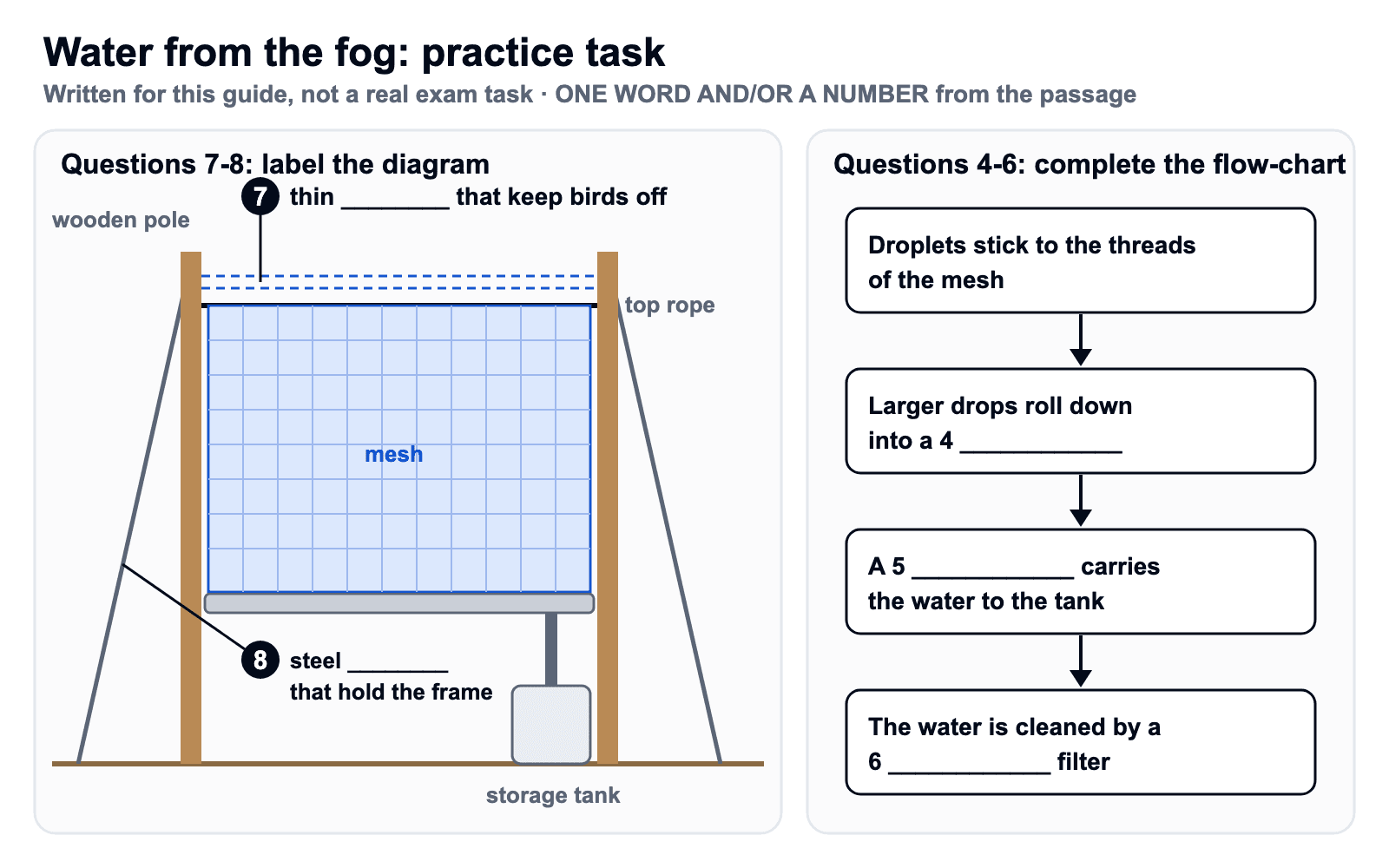
| Question | Where it is | What to complete |
|---|---|---|
| 4 | Flow-chart, step 2 | Larger drops roll down into a ______ |
| 5 | Flow-chart, step 3 | A ______ carries the water to the tank |
| 6 | Flow-chart, step 4 | The water is cleaned by a ______ filter |
| 7 | Diagram: along the very top, above the mesh and the top rope | thin ______ that keep birds off |
| 8 | Diagram: from the poles down to the ground | steel ______ that hold the frame |
| Question | Answer | Proof in the passage | Tempting wrong answer |
|---|---|---|---|
| 1 | sea | a thick fog rolls in from the sea | coast: that is where the town is, not where the fog comes from |
| 2 | 10 | about 4 metres high and 10 metres wide | 4: that is the height, already given in the table |
| 3 | 200 | In winter... 200 litres on a good day | 20: that is the summer figure |
| 4 | gutter | drops roll down into a gutter | edge: the gutter runs along the edge; the drops go into the gutter |
| 5 | pipe | a pipe carries the water downhill | downhill: it says how, not what carries the water |
| 6 | sand | passes through a sand filter | sand filter: filter is already printed, so the line would read sand filter filter |
| 7 | wires | a row of thin wires above it | rope: birds perched on the rope; the wires keep them off |
| 8 | cables | held in place by steel cables fixed to the ground | poles: the poles hold the mesh, and they are wooden |
Here is how three of the answers are found, step by step:
| Gap | Anchor and passage | Why this answer |
|---|---|---|
| 3 Best output, winter: up to ___ litres | winter → In winter… one collector can produce 200 litres on a good day | Best output = on a good day. 20 is the summer figure in the same sentence |
| 6 cleaned by a ___ filter | cleaned → passes through a sand filter | filter is already printed, so only sand is missing |
| 7 thin ___ that keep birds off | birds → Birds also perched on the top rope… adding a row of thin wires above it | The wires were the fix for the birds. The birds perched on the rope, so it doesn't keep them off |
Now notice the order of questions 7 and 8. Label 7 is at the top of the picture, but the passage describes the cables (label 8) first and the wires (label 7) after them. If you filled the labels in the order you read the text, you would have swapped them and lost both marks.
Completion gaps are a few marks per passage, and your band comes from all 40 answers. Here is how GoPrep students' overall scores moved across their mock exams:
Common completion traps
- The neighbour word. The answer sits in a sentence with other words of the same kind: 4 and 10, 200 and 20, sea and coast. Read the whole sentence and match the exact detail the gap asks for.
- The repeated word. The word before or after the gap is already printed. Writing it again breaks the line and can break the limit.
- The wrong form. If the gap needs rolled and you found roll, keep looking. You copy words from the passage; you don't change them.
FAQ
What is note completion in IELTS Reading?
It is a task where you complete short notes about part of the passage with words taken from the passage. Some tasks give a list of words to choose from instead. IELTS groups notes with summary, table and flow-chart completion; follow the word limit printed in each task.
Do table completion answers follow the order of the text?
Not always. IELTS says the answers may not come in the same order as in the text, but they usually come from one part of it, so find that part first and search inside it.
Can I change the form of a word from the passage?
No. Copy the word as it appears in the passage. If it does not fit the grammar of the gap, you have most likely found the wrong word.
How do I count words in a completion answer?
Count every word you write, including a and the. A hyphenated word such as check-in counts as one word, and a limit like NO MORE THAN TWO WORDS AND/OR A NUMBER lets you add a number to the words.
How is diagram label completion different from table completion?
The skill is the same, but a diagram is organised by position, not by order. Find the part of the passage that describes the machine or process, then match each description to its place on the picture.
Are these tasks in General Training Reading too?
Yes. The official list of General Training Reading question types includes summary, note, sentence, table and flow-chart completion, and diagram label completion, and the same method works.
What if the task gives me a list of words?
Then you choose from the list instead of copying from the passage. Pick the option that means the same as the passage, and check that it fits the gap grammatically.
What to practise next
Completion has close relatives: summary completion works on a paragraph instead of an outline, and sentence completion asks for the same exact copying, with answers in text order. To see where every Reading task fits, start from our IELTS Reading question types guide, and check how many correct answers your target needs in the IELTS Reading band score chart.
Tell the quiz your target score, your exam date and the part of IELTS you find hardest, and GoPrep will build a personal study plan around your answers.
P.S. The full completion and diagram labelling lessons, with more practice, are in the GoPrep course.

GoPrep Team
GoPrep guide authors
We write about IELTS preparation using platform data and official exam materials.
All articles by GoPrep Team